
by: Abdullah Fahim[1]
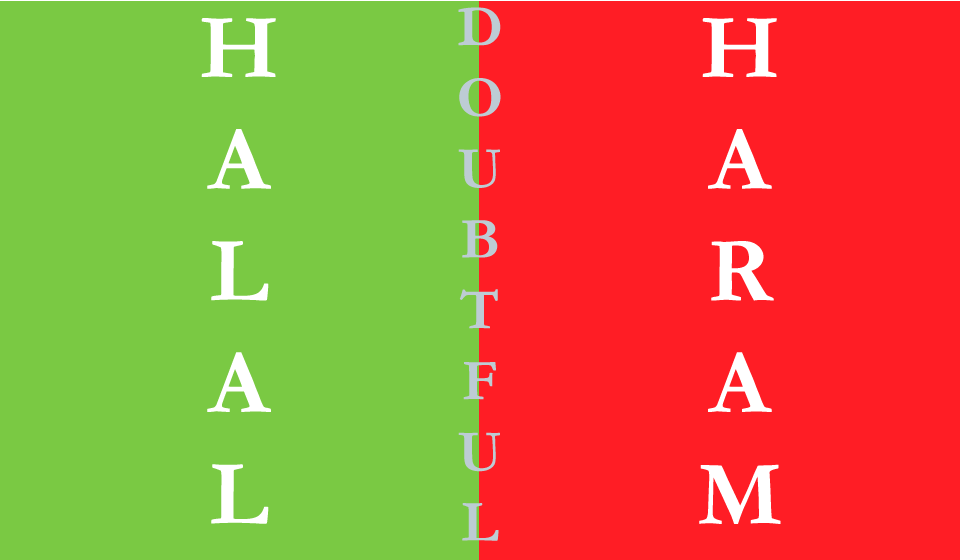
In this world, there are two things: good and evil. Sometimes there are things which fall in between them, which are known as the matters falling in ‘the grey area’. According to Islamic teachings, all the good things are considered ‘Halal’ or permissible, and all the evil things are considered ‘Haram’ or forbidden. Whether something is good or evil can either be realised by their inherent beauty or by the injunctions ordained by Allah Almighty and All-knowing. As a Muslim, it is of utmost importance to remember that the heart of Islamic teachings is to abide by what is Halal and refrain from what is Haram. Anything that falls in ‘the grey area’ should also be avoided as far as possible.
Islam as a complete code of life which provides guidance about every aspect of life. A person’s economic life, i.e. his livelihood is not different from this too. Thus, we find that Allah Almighty commands us to search for our livelihood. In Surah Jumuah (the Holy Qur’an, Chapter: 62), Verse 10, Allah Almighty proclaims that when the Jumuah (Friday) prayer finishes: ‘disperse in the land and seek the grace of Allah’.
‘Seeking grace’ has been explained by the scholars to mean: seeking one’s livelihood. However, this search for livelihood should be conducted in accordance with the guidelines provided by Allah and His Messenger (sallallahu alaihi wa sallam). In Surah Baqarah (Chapter: 2), Verse 168, Allah Almighty decrees: ‘O people, eat Halal (permissible) good things out of what lies on the earth.’ Consequently, the task of seeking livelihood is not an absolute and unrestricted enterprise; rather, it is qualified by the fact that the sources of earning must be Halal and lawful.
In one of the most comprehensive, yet concise, Hadith, the Noble Messenger (sallallahu alaihi wa sallam) summarised the rulings of Halal and Haram and that which falls in the ‘grey area’. He says:
“What is Halal is evident and what is Haram is evident, and in between them are doubtful things which many people do not know. So, he who guards against doubtful things keeps his religion and honour blameless, and he who indulges in doubtful things indulges in fact in Haram things, just as a shepherd who pastures his animals round a preserve will soon pasture them in it. Beware, every king has a preserve, and the things God has declared Haram are His preserves. Beware, in the body there is a piece of flesh; if it is sound, the whole body is sound and if it is corrupt the whole body is corrupt, and, listen, it is the heart.” (Sahih Muslim: 1599)
Indeed, this Hadith has made it very clear that in order to succeed in refraining from Haram, a person must avoid doubtful actions and transactions too. Moreover, as seeking Halal earning has been mandated, this necessitates the conclusion that seeking knowledge about sources of Halal earnings is obligatory too. Thus, it is narrated about Umar (radhiyallahu anh) that he would say: ‘Nobody except the person who has knowledge (about the laws of sales) should sell in our market. Otherwise, he will consume interest whether he wants it or not.’ (Al-Mu’aamalaat al-Maaliyyah al-Mu’aasirah, D Wahbah Al-Zuhaily)
The significance of this command is reflected in the benefits that result from abiding by Halal, and harms that stem from not avoiding what is Haram.
Once a famous Sahabi (companion), Sa’d bin Abi Waqqas (radhiyallahu anh) asked the Messenger (sallallahu alaihi wa sallam) to pray for him to become a person whose prayers are always accepted. The Messenger (sallallahu alaihi wa sallam) replied: ‘Purify your diet, you will become a person whose prayers are always accepted’ (Tabarani). In another Hadith, Abu Hurairah (radhiyallahu anh) narrates that the Messenger (sallallahu alaihi wa sallam) said:
“O people, Allah is pure, and He accepts only that which is pure. And Allah commanded the believers what He commanded the Messengers: “O Messengers, eat of the pure things, and do good deeds. Verily, I am aware of what you do”. And He said: “O those who believe, eat of the pure things that We gave you”.
He then made a mention of a person who travels widely, his hair dishevelled and covered with dust. He lifts his hand towards the sky (and thus makes the supplication): “O Lord, O Lord,” whereas his diet is Haram, his drink is Haram, and his clothes are Haram and his nourishment is Haram. How can then his supplication be accepted?”
In this Hadith, how powerfully the Messenger (sallallahu alaihi wa sallam) questions the prospect of the acceptance of a person’s prayer, whose earnings are from Haram sources! Indeed, this Hadith sends a stark warning to all believers regarding the injunctions of Halal and Haram.
The importance of avoiding what is Haram in seeking livelihood becomes clearer when we study and analyse the harms resulting from what has been declared Haram. The major Haram transactions in Islam are: Riba (interest) based transactions, Qimaar or gambling and Gharar or excessively risky and uncertain transactions.
In addition to severe punishment for some of these transactions in the Afterlife, their extremely negative impacts on an individual’s economic life, as well the economy of a nation, have been documented by empirical evidences. It is an undeniable fact that the proliferation of interest-based transactions, gambling and highly risky activities have led to the world economy becoming permanently volatile, uncertain and prone to financial crisis. The fact that a person can profit from merely providing money to others – which is what charging interest entails – certainly impedes productivity and growth, and disincentivises creativity, entrepreneurship and other enterprises.
Similarly, in addition to causing addiction, gambling leads to laziness and creates false hopes and dreams. Only Allah knows how many lives and families have been destroyed by gambling and excessive risk-taking!
It is another bitter truth that the above Haram activities have widened the gap between the rich and the poor around the world. The shackles of indebtedness have crippled the economies of poorer and developing countries and have virtually made them slaves of the rich and the powerful countries.
In fact, the root cause of the most recent financial crisis of 2008 was diagnosed as something known as ‘subprime mortgages’. These so-called mortgages consisted of extremely risky financial products, such as CDOs (Collateralised Debt Obligations) and CDSs (Credit Default Swap). In addition of being composed of interest-based products, they also involved Qimaar and Gharar – which are all the major prohibitions in Islamic commercial law. (Mufti Taqi Usmani, Causes and Remedies of the Recent Financial Crisis from an Islamic Perspective, Turath Publishing).
Apart from the above, some other Haram activities include: selling an item before owning it or before taking possession of the item, unlawful appropriation of another person’s wealth, stealing, robbing and hoarding etc. There is no doubt that banning all these activities and enforcing that will guarantee financial stability, economic growth and prosperity and happiness for everyone in society.
In conclusion, the importance of refraining from Haram economic activities is an undeniable truth and it is magnified by the benefits that it brings to everybody. Islam as a complete system of life instructs its followers to avoid Haram activities in their economic life. There is no doubt that this will guarantee economic well-being, prosperity and welfare for everybody. As Muslims, we must realise that seeking Halal income will bring success and happiness; whereas, chasing wealth, without paying any regard to divine instructions, will only lead to misery, financial instability and economic downfall.
[1] Alimiyyah (Jamia Islamia Birmingham), LLB (University of Birmingham), LLM in Corporate Law (University College London), Imam & Khateeb (Masjid Taqwa, Birmingham, United Kingdom)